Blog #53 Vest Necklines
Dear Knitter,
I have accumulated several vest-knitting questions; the first is multiple questions in one, for which I have multiple answers. Also, below the text, I have pictured multiple neck shapes, which enables you to compare the relative width and depth of each style.
Q1. I’d like to know if there’s an EPS-like set of ratios for neck width/depth/shape (V, round, squarish) and the relation of the neck opening to the armhole opening (when to start the neck opening after having started the armhole steeks).
A1. I have no specific percentage answer for neck-width since people’s heads tend to be similar in size, despite a wide range of body circumferences. For any kind of lowered neck, I use as a guideline a ± 8" wide opening at the top (be sure to consider the width of the border you will add later). To assure that a pullover will fit over the head with ease, be aware of the depth of the opening. If you make a deep V- or U-neck, the top can be relatively narrow (about 5-8” wide after the added border). However, a shallow depth (like a boat-neck, or an opening only about 2-3” deep) may require a wider horizontal opening; approximately 9-10" wide. Keep in mind that the elasticity of the knitted fabric or border may make a narrower neck possible. A ribbed border will give more easily than an i-cord bordered neckline.
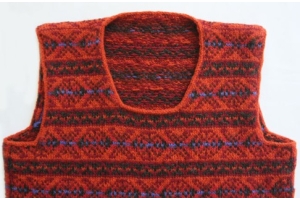
For a V-neck (photo 1 Fair Isle Vest below), I put three sts onto a holder (perfectly centered), and cast on the steek. Dec each side of the steek e.o.r until you have consumed 8" worth of sts, then work straight to wanted shoulder height. When knitting on the border, those three sts are immediately decreased to one with a cdd (centered dbl-dec: sl 2 k’wise, k1, p2sso; which keeps the shaping centered and symmetric). Repeat the cdd every round.
A2. As for when to begin the V, my mother liked a relatively shallow V starting 4-5 inches above the underarm; I like it deeper, and usually begin about 1-2" after the underarm. Some like super deep Vs and may begin before the underarm. With a deeper V, you generally want to change your decreasing to every 3rd or 4th round, for a steeper angle.
A3. Round Neck. For a crew-neck, consider maybe 1-3" in total depth? For shallow openings, I would add 1+" to the top width, and put most of the sts onto a thread at the base of the neck. Then establish your steek, and dec each side of steek every round to wanted width. The Swedish sweater pictured below, while squared off in front, comes closest to this depth, and the ribbing adds elasticity needed for the sweater to fit over the wearer's head. It's possible to round that entire neckline.
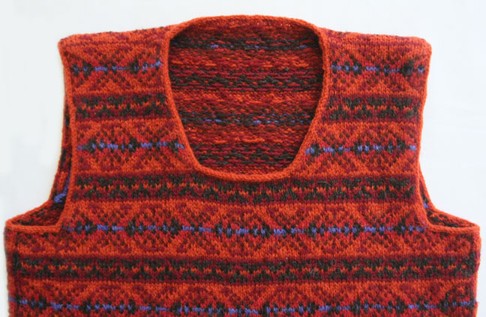
A4. Square Neck. Decide how deep you want it and put the full 8" worth (or whatever final width you want) of sts onto a holder. Add steek, and work straight to shoulder height. When knitting the border, work a cdd at each lower corner for a square front and rounded back. Or, cdd all 4 corners for a full square. If you make no dec at the corners, it will be oval.
Q2. “Attaching front to back at the shoulders....use I-cord, 3-needle cast off, crochet?”
A. Without any sleeves to tug at a loose shoulder seam, you don’t need any of the above for stability. I like to make the shoulders seamless by weaving them together invisibly. You can weave in pattern if you like by grafting all sts of one color first; then graft the rest in the 2nd color.
Or, weave all sts in the background color and duplicate stitch the pattern color.
Or weave in a single solid color as I did for the vest in WG#115.
Fair Isle Vest Photo 1
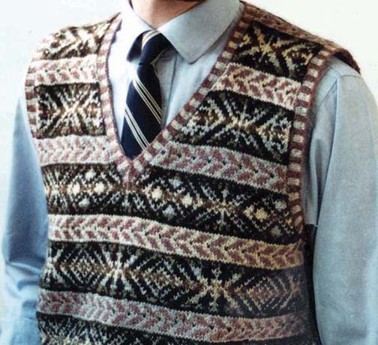
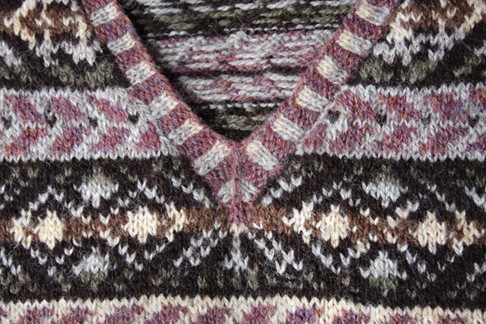
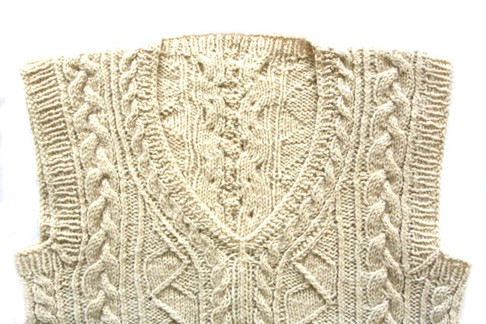
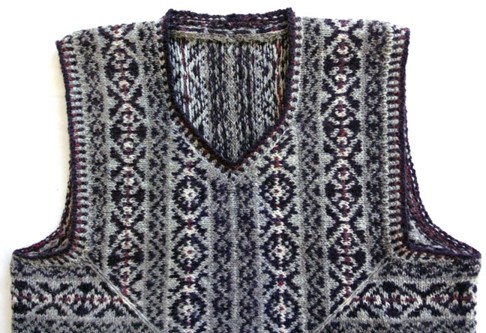
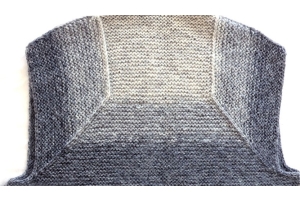
(Photos Above: 1. Centered V with cdd at the apex of corrugated border; 2. Wide, deep V with shaping outside the narrow cables; 3. Shallow, Narrow V)
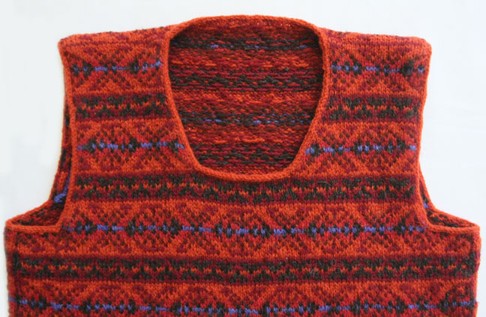
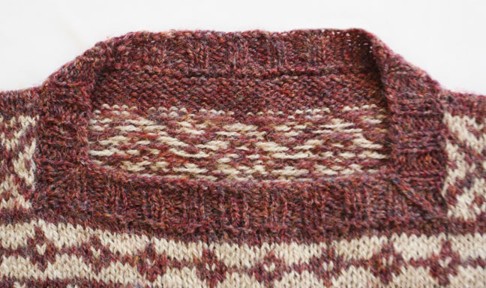
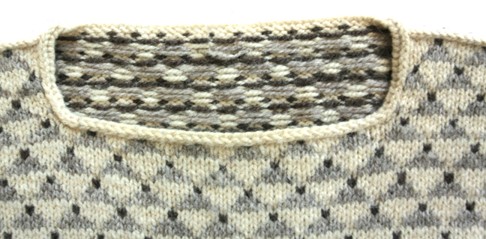
(Photos above: 1. WG#115 has a U-Neck, bordered with I-Cord (woven shoulders); 2. Front corners are double-decreased; back corners are ignored,
which makes them rounded. (Swedish Halland sweater); 3. Very wide square neck bordered with (k1, p1, k1) I-Cord.)
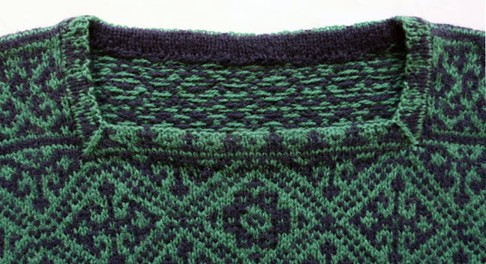
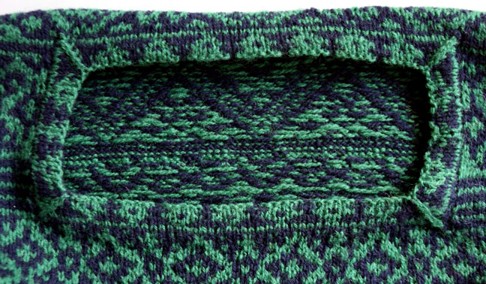
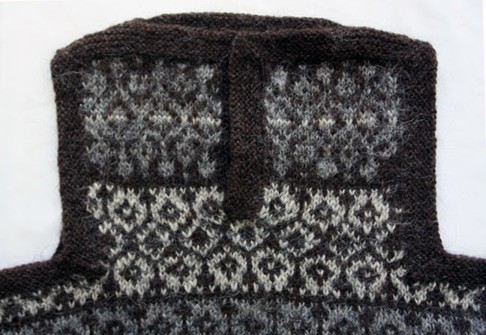
(Photos Above: 1. A square with 4 mitered corners, and a hem in laceweight; 2. This shows all 4 corners decreased with cdds. 3. Henley neckline with garter-stitch trim.)
What is a Kangaroo Pouch?
As time passes, knitting techniques are discovered (‘unvented’ as EZ would say), altered, improved, forgotten, and re-discovered. The terms for these techniques also undergo revisions.
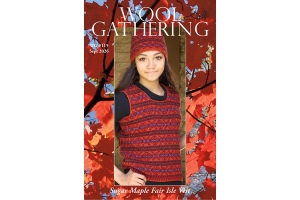
Because the Sugar Maple Fair Isle Vest uses steeks in order to be knitted entirely in the round, I revisited a term Elizabeth Zimmermann used at the outset of her exploration into seamless, circuclar garments.
EZ’s ‘Kangaroo Pouch’ technique was originally named in her first book, Knitting Without Tears (1971). It actually became the name of the striped sweater on page 83. The garment was EZ’s first attempt to knit a Set-In-Sleeve sweater entirely in the round*.
Working the body up from the lower edge, she put about 30 sts on threads at each underarm, and cast on a few ‘cutting sts’ (we hadn’t yet heard the word steek - which was introduced to us through Sheila McGregor’s Traditional Fair Isle Knitting book in 1981; huge excitement!).
As Elizabeth continued around the body, the two bulges at the sites of the armhole-steeks reminded her of kangaroo pouches for Baby Roo; thus her apt name.
In today’s knitting world, the temporary bulges seem not to be mentioned much and the entire process is usually referred to as ‘steeking’. EZ’s early term of ‘kangaroo pouch’ is synonymous with the steeking process.
There is an excellent demonstration video on steeks, kangaroo pouches, and executing these techniques in A Knitting Glossary DVD or streaming, which also has over 100 other techniques demonstrated by Meg and Elizabeth, plus 30 “new” ideas (unknown to EZ and MS in 1980), taped by Cully and Meg many years later.
*In subsequent years, Elizabeth vastly improved her circular, seamless Set-In-Sleeve sweater, and completely eliminated both the pouches and the cutting. See pp 60-61 in her (updated) Knitting Workshop book.
Good Knitting,
Meg
I am going to bring all my EZ and Meg books down and enjoy going through them, again, and add this post to my knitting bible.
I often rewatch the knit-along DVD’s from SchoolHousePress. There is nothing else better.
Hugs and love to you.